


Your staff are already using AI. And they won't stop nor should they. It saves time. It drafts their reports. It answers their questions at midnight.
The question is not whether your staff are using AI — they are. The question is whether they are doing it in a way that protects your organisation, or one that puts it at risk.
Our Training Programme is your organisation’s licence to use AI with confidence
We build the capacity of your people: board, management, and technical staff to use AI responsibly and productively, without putting your organisation’s reputation at risk.
We offer three targeted modules, designed for every level of your organisation, from the board that sets strategy, to the managers who govern AI use, and to the technical staff who use, build, and deploy AI systems.
Every participant leaves our training with the ability to use AI tools responsibly to increase their productivity, accelerate their work, and deliver better results.
They will know how to look at any AI-generated output — a report, data analysis results, a funding proposal, a client communication and act responsibly before it carries your organisation’s name into the world.
Fundamentals of Responsible AI
AI Ethical Leader
Responsible Analyst
The Reality Every Organisation Must Accept
AI is not coming. It is already here — inside your organisation, on your employees’ computers and phones, in their reports, and in the communications going out from your organisation.
Organisations that treat AI as a threat to be avoided will find themselves outpaced, outperformed, and eventually irrelevant.
Organisations that embrace it responsibly will be at the forefront of a revolution reshaping every industry, every government, and every sector across Uganda and the world.
Every organisation has only two choices:
be at the forefront of this unstoppable digital revolution,
or be swallowed by it.
Ask Nokia.
For Employees
AI will not replace you. But a person using AI will.
And if you are using AI irresponsibly — submitting unverified outputs, passing off fabricated references, sharing outdated data, a person using AI responsibly will replace you too.
It is not about using AI. It is about using it well.
AI Is Powerful. But Power Without Knowledge Is Dangerous
Imagine a funder opening your organisation’s report and finding the tell-tale signs of AI output in the fourth paragraph:
“I cannot browse the internet…” “Let’s not talk about…” A reference that does not exist. A statistic that is three years out of date. A figure that was never accurate to begin with.
That funder does not call to ask for a correction. They quietly move their funding elsewhere and consider you a mediocre organisation.
AI is not a magic solution. Used without knowledge, AI systems can cause significant harm such as exposing organisations to legal liability, reputational damage, and ethical failure.
The question is not whether to adopt AI. It is whether to do so responsibly.
The Benefits of Responsible AI Adoption to Your Organisation

Multiply your team’s output
AI handles the time-consuming — drafting, summarising, translating, formatting, so your people focus on what only humans can do: relationships, strategy, etc.

Better decisions, faster
AI analyses large datasets in seconds, generating insights that would take analysts weeks. Programme data, donor trends, M&E results understood and acted on in real time.

Reach more people, serve better
AI-powered translation, localisation, and communication tools allow organisations to engage communities in their own languages, breaking barriers that previously cost a team weeks of work.

Do more with less
AI reduces operational costs, automates repetitive processes, and stretches limited budgets further, critical for NGOs, SMEs, and government agencies operating under resource constraints.

Competitive advantage
Organisations that build AI capability now will attract better talent, win more funding, and deliver stronger results. Donors and clients increasingly expect AI-informed, evidence-based work.

Build trust through responsible use
Organisations that govern AI transparently, with clear policies, trained staff, and ethical frameworks build greater trust with funders, partners, regulators, and the communities they serve.

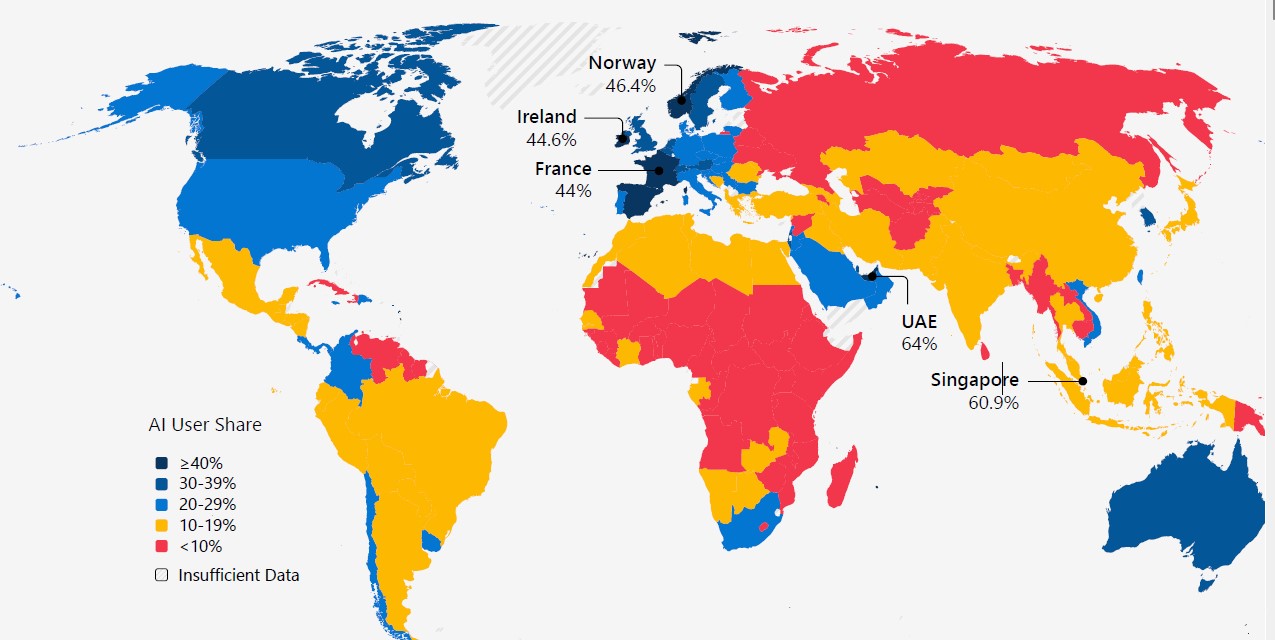
The Global Picture of AI Adoption and Where Uganda Stands
Uganda vs the World: The AI Adoption Gap
| No. | Country | H1 2025 | H2 2025 | Change |
| 1 | United Arab Emirates | 59.4% | 64.0% | +4.6% |
| 2 | Singapore | 58.6% | 60.9% | +2.3% |
| 3 | Norway | 45.3% | 46.4% | +1.1% |
| 4 | Ireland | 41.7% | 44.6% | +2.9% |
| 5 | France | 40.9% | 44.0% | +3.1% |
| 6 | Spain | 39.7% | 41.8% | +2.1% |
| 18 | South Korea ★ Fastest riser (+7 places) | 25.9% | 30.7% | +4.8% |
| — | Global South average | 13.1% | 14.1% | +1.0% |
| — | Uganda ▲ Rising | 6.4% | 6.8% | +0.4% |
Source: Microsoft AI Economy Institute’s Global AI Adoption in 2025